 Knitting Chart
Yarn Weight Chart
Yarn comes in 8 standard weights, from 0 Lace to 7 Jumbo. DK — category 3, called 8 ply in Australia — knits about 21–24 stitches per 4 in (10 cm) on 3.75–4.5 mm (US 5–7) needles.
What weight is my yarn?
Yarn weight chart
| Weight | Also called | UK | Australia & NZ | Knitting needles | Stitches per 4 in / 10 cm | Meters per 100 g | WPI | Crochet hook |
|---|---|---|---|---|---|---|---|---|
| 0 Lace | Lace, light fingering, thread | 1 ply, 2 ply | 2 ply | 1.5–2.25 mm US 000–1 | 33–40 | 600+ m (656+ yd) | 18+ | Steel 1.4–1.6 mm, regular 2.25 mm (B-1) |
| 1 Super Fine | Fingering, sock, baby | 4 ply | 4 ply | 2.25–3.25 mm US 1–3 | 27–32 | 350–450 m (383–492 yd) | 14 | 2.25–3.5 mm (B-1 to E-4) |
| 2 Fine | Sport, baby | 5 ply, sport | 5 ply | 3.25–3.75 mm US 3–5 | 23–26 | 250–350 m (273–383 yd) | 12 | 3.5–4.5 mm (E-4 to 7) |
| 3 Light | DK, light worsted | DK (double knit) | 8 ply | 3.75–4.5 mm US 5–7 | 21–24 | 200–250 m (219–273 yd) | 11 | 4.5–5.5 mm (7 to I-9) |
| 4 Medium | Worsted, aran, afghan | Aran | 10 ply | 4.5–5.5 mm US 7–9 | 16–20 | 120–200 m (131–219 yd) | 8–9 | 5.5–6.5 mm (I-9 to K-10½) |
| 5 Bulky | Chunky, craft, rug | Chunky | 12 ply | 5.5–8 mm US 9–11 | 12–15 | 100–130 m (109–142 yd) | 7 | 6.5–9 mm (K-10½ to M-13) |
| 6 Super Bulky | Super bulky, roving | Super chunky | 14 ply | 8–12.75 mm US 11–17 | 7–11 | under 100 m (under 109 yd) | 5–6 | 9–15 mm (M-13 to Q) |
| 7 Jumbo | Jumbo, roving | — | — | 12.75 mm and larger US 17 and larger | 6 or fewer | under 100 m (under 109 yd) | 4 or fewer | 15 mm and larger (Q and larger) |
Lace yarns are usually knitted on larger needles for an open fabric, so their gauge varies — follow your pattern.
3 ply (light fingering) sits between Lace and Super Fine: Ravelry files it under 0, Wikipedia under 1.
Meters per 100 g and WPI are typical values where Wikipedia, Skein Sisters, Knitting Naturally and Ravelry agree; the Craft Yarn Council gives no lengths.
Guidelines only: the categories reflect the most commonly used gauges and needle sizes.
Categories, gauge, needle and hook sizes — Craft Yarn Council, Standard Yarn Weight System.
Names, lengths and WPI: Ravelry, Standard Yarn Weights · Skein Sisters, A Quick Guide to Yarn Weights · Wikipedia, Yarn weight · Knitting Naturally, Yarn Comparison Chart
Checked November 2026.
How to find your yarn weight
Look for the number
The number on the label, 0 to 7, is the yarn weight.
Enter the label
No number? Enter the length and weight from the label in the calculator above.
Count wraps per inch
Without a label, wrap the yarn around a ruler without stretching it, count how many wraps fill 1 in (2.5 cm), and compare with the WPI column in the chart.
Knit a swatch
Knit a small swatch on the recommended needle size, then count your stitches per 4 in (10 cm) and check them against the chart.
Yarn weight explained
Yarn weight means thickness. The name is a little misleading: every ball has a weight in grams, but a 50 g ball of fingering yarn is far longer than a 50 g ball of bulky. That is why the chart above gives meters per 100 g: the thinner the yarn, the more length there is in the same weight.
Fiber does not set the weight. Wool, cotton, acrylic and blends come in every weight, though a dense fiber such as cotton has fewer meters per 100 g than wool of the same thickness. So match the category number or the gauge on the label, not the fiber, when you substitute one yarn for another.
Yarn units: yarn is sold by weight, in grams (often 50 g or 100 g) or ounces, with the length given in meters or yards. It comes wound as balls, skeins, cakes or hanks; a hank is a loose twisted loop that you wind into a ball before knitting.
Yarn weight conversion chart: US, UK and Australian names
| Australia & NZ | UK | US |
|---|---|---|
| 2 ply | 1 ply, 2 ply | 0 Lace (Lace, light fingering, thread) |
| 4 ply | 4 ply | 1 Super Fine (Fingering, sock, baby) |
| 5 ply | 5 ply, sport | 2 Fine (Sport, baby) |
| 8 ply | DK (double knit) | 3 Light (DK, light worsted) |
| 10 ply | Aran | 4 Medium (Worsted, aran, afghan) |
| 12 ply | Chunky | 5 Bulky (Chunky, craft, rug) |
| 14 ply | Super chunky | 6 Super Bulky (Super bulky, roving) |
US patterns use names — fingering, sport, DK, worsted and bulky. British patterns use ply for fine yarns and DK, Aran and Chunky for thicker ones.
Australian and New Zealand patterns use ply too: 4, 5, 8, 10, 12 and 14 ply, often written without the space (4ply, 8ply).
In these names, ply is a description of thickness, not a count of strands. A “4-ply” on a US label does mean four strands, and those strands can make any weight, so check the category number or the meters per 100 g. To read the needle sizes in the chart against a pattern, use the knitting needle size chart.
Printable yarn weight cheat sheet (PDF)
Keep a one-page copy in your project bag: all 8 Craft Yarn Council weights (0 Lace to 7 Jumbo), US, UK and Australian ply names, recommended needles and crochet hooks, meters and yards per 100 g, wraps per inch, and the ball-band conversion formulas on one US Letter / A4 sheet.
Yarn weight conversion sheet (0 Lace to 7 Jumbo)
One-image summary of all 8 Craft Yarn Council categories with US, UK and Australian names, needle ranges, 10 cm stitch gauges, meters per 100 g and wraps per inch.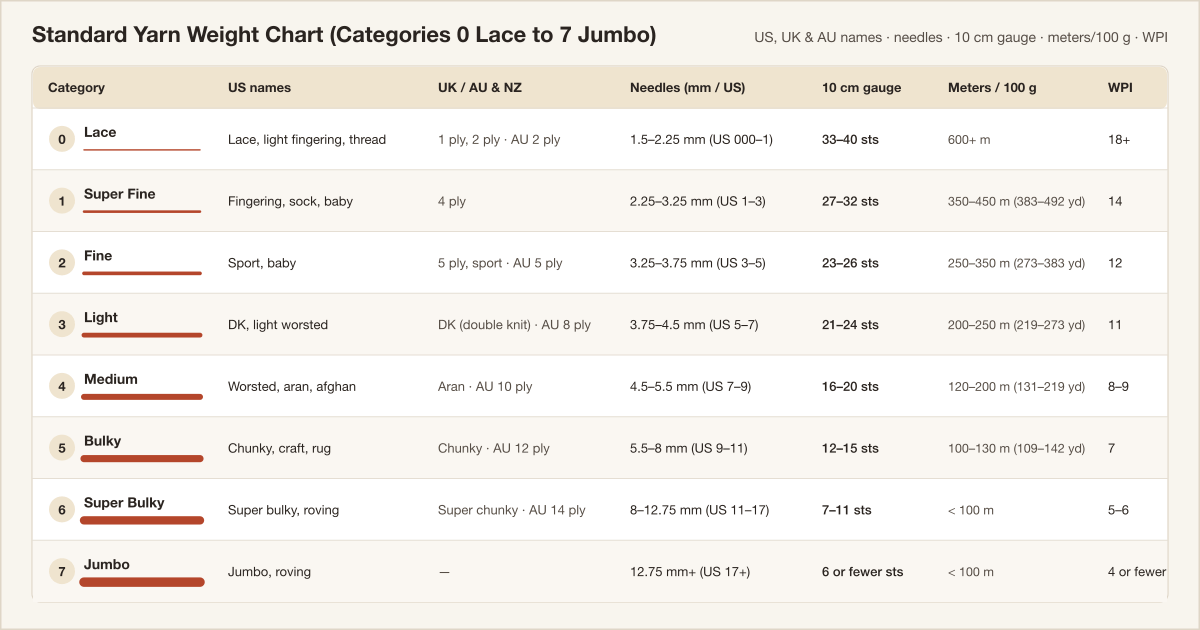
Questions about yarn weights
What does yarn weight mean?
Yarn weight is how thick the yarn is, not how heavy the ball is: a 100 g ball of lace yarn and a 100 g ball of bulky yarn weigh the same, but the lace one is many times longer. The weight tells you which needles to use and how many stitches make 4 in (10 cm).
What are the yarn weights?
There are 8 yarn weights, from 0 Lace to 7 Jumbo: 0 Lace, 1 Super Fine, 2 Fine, 3 Light, 4 Medium, 5 Bulky, 6 Super Bulky and 7 Jumbo. The categories come from the Craft Yarn Council.
Is DK the same as 8 ply?
Yes. In the UK, DK (double knit) is the name for 3 Light; in Australia and New Zealand it is 8 ply. It knits at 21–24 stitches per 4 in (10 cm) on 3.75–4.5 mm (US 5–7) needles.
What is the difference between worsted and aran?
Worsted and aran are both 4 Medium. Aran is the British name and usually a little thicker: Ravelry gives aran 8 WPI and worsted 9 WPI.
What weight is 4 ply yarn?
In the UK, Australia and New Zealand, 4 ply is fingering, 1 Super Fine: 27–32 stitches per 4 in (10 cm) on 2.25–3.25 mm (US 1–3) needles. On a US label, “4-ply” means the yarn is made of 4 strands, not that it is 4 ply.
How do I determine the weight of a yarn without a label?
Count the wraps per inch: wrap the yarn around a ruler without stretching it, count how many wraps fill 1 in (2.5 cm), and match that number to the WPI column above. Or measure 10 m of yarn, weigh it, and enter both numbers in the calculator above.
Can I combine yarn weights by holding two strands together?
Yes. Choose 2 or 3 under Strands held together in the calculator. Two strands halve the meters per 100 g: a fingering yarn at 400 m per 100 g becomes 200 m per 100 g — the boundary between 3 Light and 4 Medium. Knit a swatch to confirm the gauge.
What size needles for worsted weight yarn?
Use 4.5–5.5 mm (US 7–9) needles for worsted weight yarn. The knitting needle size chart converts those sizes to UK and Japanese sizes.
How many meters per 100 g is DK yarn?
DK usually gives 200–250 m (219–273 yd) per 100 g.
How many yards are in a skein of yarn?
It depends on the yarn weight and ball size: per 100 g (3.5 oz), 1 Super Fine fingering runs 350–450 m (383–492 yd), 3 Light DK runs 200–250 m (219–273 yd), 4 Medium worsted runs 120–200 m (131–219 yd), and 6 Super Bulky stays under 100 m (under 109 yd). For a 50 g ball, halve those lengths, or weigh a leftover ball on a kitchen scale and multiply its grams by the label’s yards per gram.
How much yarn do I need to knit a scarf or a blanket?
In 4 Medium worsted yarn, an adult scarf (about 18 × 175 cm / 7 × 70 in) takes roughly 350–450 yd (320–410 m, or two 100 g skeins), a baby blanket (75 × 90 cm / 30 × 36 in) takes 700–1,000 yd (640–915 m), and a throw blanket (125 × 150 cm / 50 × 60 in) takes 1,500–2,200 yd (1,370–2,010 m). For an exact count in your stitch pattern, knit and weigh a 10 × 10 cm (4 × 4 in) swatch, multiply by how many swatch squares fit into your finished piece, and add 10% for edging and ends.
Keep going
- Knitting Needle Size Chart
Convert the needle size on your label between mm, US, UK and Japanese sizes.
- Knitting Chart Maker
Draw a colorwork or stitch chart in true stitch proportions and print it with a key.