Black Friday 32% off Lifetime Pro · ends to Nov 30 →

Black Friday: 32% off Lifetime Pro

Black Friday: 32% off Lifetime Pro at knittingchart.com

One payment · Never renews Save $18.88

Was $59 $40.12 once

See Black Friday deal →
Auto-applied · Ends Nov 30 (PT) · USD, tax included

Free Mosaic Knitting Charts

Here are 6 free mosaic knitting charts: Slip-stitch tweed, Windowpane, Diagonal steps, Box chain, Greek key and Chevron. Their repeats run from 4 to 10 stitches and from 4 to 12 chart rows, every chart was checked stitch by stitch against the mosaic rule (0 problem stitches in 2,200 squares), and every one has written rows for both the right and wrong sides. Download all 6 as one PDF, or open any chart in the free editor to change the colors, the size or the gauge.

The 6 mosaic charts

Each card shows the chart as it is worked, a preview in garter-stitch proportions (one chart row is about as tall as a stitch is wide), the numbers that decide how to knit it, and the written rows for both sides. A is the main color and B the contrast; in the written rows k is knit, sl is slip purlwise, wyib is with the yarn in back and wyif is with the yarn in front.

Slip-stitch tweed

Colors: A B

12111098765432122212019181716151413121110987654321
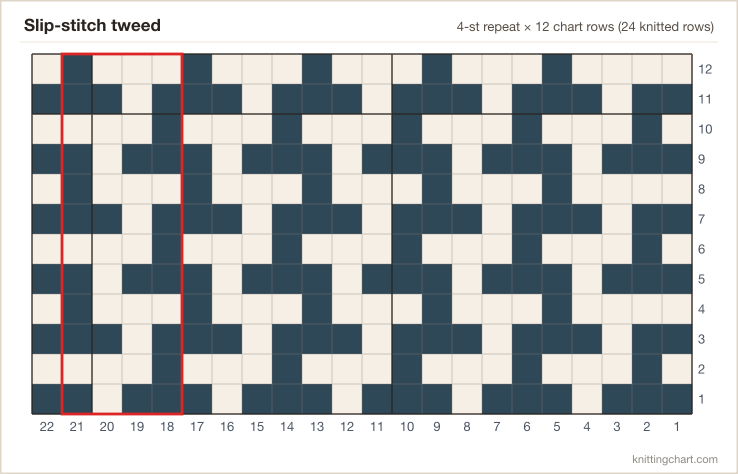
The chart as it is worked; the red box marks one 4-stitch repeat. Row 1 is at the bottom and stitch 1 on the right.
The whole chart in garter-stitch proportions, one chart row as tall as a stitch is wide, so the pattern knits close to the drawing
  • Cast on a multiple of 4 plus 2 edge stitches; the chart is 22 stitches wide (5 repeats plus the edges).
  • 12 chart rows = 24 knitted rows; the longest run of slipped stitches is 1 stitch.
  • At DK, one repeat is about 1.8 × 1.8 cm (0.7 × 0.7 in).

Checked: every slipped stitch sits on its own color and every edge stitch is in the working color (0 problem stitches).

The easiest first mosaic and a good swatch to learn the technique on. It makes a flecked, firm fabric for cowls, hat brims and dishcloths.

Written rows (24 rows, both sides)

Read from row 1 at the bottom. Each chart row is two knitted rows, right side then wrong side.

Row 1 (RS) with B: k3, sl1 wyib, k3, sl1 wyib, k3, sl1 wyib, k3, sl1 wyib, k3, sl1 wyib, k2

Row 2 (WS): k2, sl1 wyif, k3, sl1 wyif, k3, sl1 wyif, k3, sl1 wyif, k3, sl1 wyif, k3

Row 3 (RS) with A: k1, sl1 wyib, k3, sl1 wyib, k3, sl1 wyib, k3, sl1 wyib, k3, sl1 wyib, k4

Row 4 (WS): k4, sl1 wyif, k3, sl1 wyif, k3, sl1 wyif, k3, sl1 wyif, k3, sl1 wyif, k1

Row 5 (RS) with B: k2, sl1 wyib, k3, sl1 wyib, k3, sl1 wyib, k3, sl1 wyib, k3, sl1 wyib, k3

Row 6 (WS): k3, sl1 wyif, k3, sl1 wyif, k3, sl1 wyif, k3, sl1 wyif, k3, sl1 wyif, k2

Row 7 (RS) with A: k4, sl1 wyib, k3, sl1 wyib, k3, sl1 wyib, k3, sl1 wyib, k3, sl1 wyib, k1

Row 8 (WS): k1, sl1 wyif, k3, sl1 wyif, k3, sl1 wyif, k3, sl1 wyif, k3, sl1 wyif, k4

Row 9 (RS) with B: k3, sl1 wyib, k3, sl1 wyib, k3, sl1 wyib, k3, sl1 wyib, k3, sl1 wyib, k2

Row 10 (WS): k2, sl1 wyif, k3, sl1 wyif, k3, sl1 wyif, k3, sl1 wyif, k3, sl1 wyif, k3

Row 11 (RS) with A: k1, sl1 wyib, k3, sl1 wyib, k3, sl1 wyib, k3, sl1 wyib, k3, sl1 wyib, k4

Row 12 (WS): k4, sl1 wyif, k3, sl1 wyif, k3, sl1 wyif, k3, sl1 wyif, k3, sl1 wyif, k1

Row 13 (RS) with B: k2, sl1 wyib, k3, sl1 wyib, k3, sl1 wyib, k3, sl1 wyib, k3, sl1 wyib, k3

Row 14 (WS): k3, sl1 wyif, k3, sl1 wyif, k3, sl1 wyif, k3, sl1 wyif, k3, sl1 wyif, k2

Row 15 (RS) with A: k4, sl1 wyib, k3, sl1 wyib, k3, sl1 wyib, k3, sl1 wyib, k3, sl1 wyib, k1

Row 16 (WS): k1, sl1 wyif, k3, sl1 wyif, k3, sl1 wyif, k3, sl1 wyif, k3, sl1 wyif, k4

Row 17 (RS) with B: k3, sl1 wyib, k3, sl1 wyib, k3, sl1 wyib, k3, sl1 wyib, k3, sl1 wyib, k2

Row 18 (WS): k2, sl1 wyif, k3, sl1 wyif, k3, sl1 wyif, k3, sl1 wyif, k3, sl1 wyif, k3

Row 19 (RS) with A: k1, sl1 wyib, k3, sl1 wyib, k3, sl1 wyib, k3, sl1 wyib, k3, sl1 wyib, k4

Row 20 (WS): k4, sl1 wyif, k3, sl1 wyif, k3, sl1 wyif, k3, sl1 wyif, k3, sl1 wyif, k1

Row 21 (RS) with B: k2, sl1 wyib, k3, sl1 wyib, k3, sl1 wyib, k3, sl1 wyib, k3, sl1 wyib, k3

Row 22 (WS): k3, sl1 wyif, k3, sl1 wyif, k3, sl1 wyif, k3, sl1 wyif, k3, sl1 wyif, k2

Row 23 (RS) with A: k4, sl1 wyib, k3, sl1 wyib, k3, sl1 wyib, k3, sl1 wyib, k3, sl1 wyib, k1

Row 24 (WS): k1, sl1 wyif, k3, sl1 wyif, k3, sl1 wyif, k3, sl1 wyif, k3, sl1 wyif, k4

Windowpane

Colors: A B

1615141312111098765432122212019181716151413121110987654321
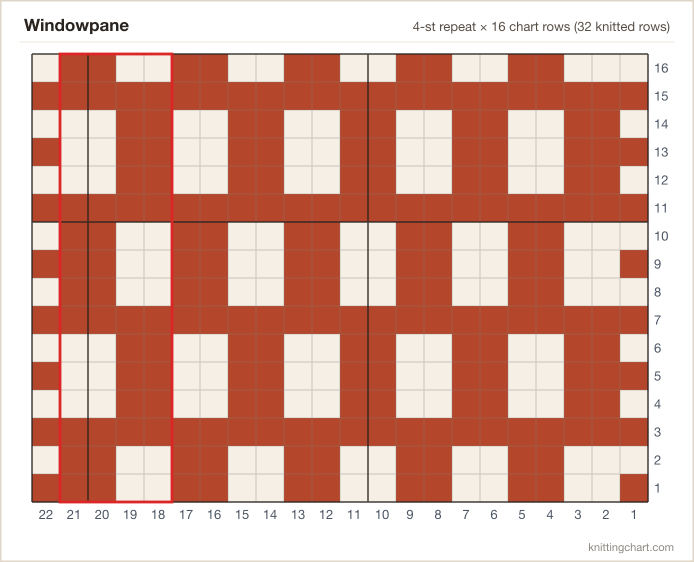
The chart as it is worked; the red box marks one 4-stitch repeat. Row 1 is at the bottom and stitch 1 on the right.
The whole chart in garter-stitch proportions, one chart row as tall as a stitch is wide, so the pattern knits close to the drawing
  • Cast on a multiple of 4 plus 2 edge stitches; the chart is 22 stitches wide (5 repeats plus the edges).
  • 16 chart rows = 32 knitted rows; the longest run of slipped stitches is 2 stitches.
  • At DK, one repeat is about 1.8 × 3.6 cm (0.7 × 1.4 in).

Checked: every slipped stitch sits on its own color and every edge stitch is in the working color (0 problem stitches).

Light panes framed by a dark grid, for blankets and the body of a sweater. The panes line up in columns, so it is easy to see where you are.

Written rows (32 rows, both sides)

Read from row 1 at the bottom. Each chart row is two knitted rows, right side then wrong side.

Row 1 (RS) with B: k1, sl2 wyib, k2, sl2 wyib, k2, sl2 wyib, k2, sl2 wyib, k2, sl2 wyib, k3

Row 2 (WS): k3, sl2 wyif, k2, sl2 wyif, k2, sl2 wyif, k2, sl2 wyif, k2, sl2 wyif, k1

Row 3 (RS) with A: k3, sl2 wyib, k2, sl2 wyib, k2, sl2 wyib, k2, sl2 wyib, k2, sl2 wyib, k1

Row 4 (WS): k1, sl2 wyif, k2, sl2 wyif, k2, sl2 wyif, k2, sl2 wyif, k2, sl2 wyif, k3

Row 5 (RS) with B: k22

Row 6 (WS): k22

Row 7 (RS) with A: k1, sl2 wyib, k2, sl2 wyib, k2, sl2 wyib, k2, sl2 wyib, k2, sl2 wyib, k3

Row 8 (WS): k3, sl2 wyif, k2, sl2 wyif, k2, sl2 wyif, k2, sl2 wyif, k2, sl2 wyif, k1

Row 9 (RS) with B: k3, sl2 wyib, k2, sl2 wyib, k2, sl2 wyib, k2, sl2 wyib, k2, sl2 wyib, k1

Row 10 (WS): k1, sl2 wyif, k2, sl2 wyif, k2, sl2 wyif, k2, sl2 wyif, k2, sl2 wyif, k3

Row 11 (RS) with A: k1, sl2 wyib, k2, sl2 wyib, k2, sl2 wyib, k2, sl2 wyib, k2, sl2 wyib, k3

Row 12 (WS): k3, sl2 wyif, k2, sl2 wyif, k2, sl2 wyif, k2, sl2 wyif, k2, sl2 wyif, k1

Row 13 (RS) with B: k22

Row 14 (WS): k22

Row 15 (RS) with A: k3, sl2 wyib, k2, sl2 wyib, k2, sl2 wyib, k2, sl2 wyib, k2, sl2 wyib, k1

Row 16 (WS): k1, sl2 wyif, k2, sl2 wyif, k2, sl2 wyif, k2, sl2 wyif, k2, sl2 wyif, k3

Row 17 (RS) with B: k1, sl2 wyib, k2, sl2 wyib, k2, sl2 wyib, k2, sl2 wyib, k2, sl2 wyib, k3

Row 18 (WS): k3, sl2 wyif, k2, sl2 wyif, k2, sl2 wyif, k2, sl2 wyif, k2, sl2 wyif, k1

Row 19 (RS) with A: k3, sl2 wyib, k2, sl2 wyib, k2, sl2 wyib, k2, sl2 wyib, k2, sl2 wyib, k1

Row 20 (WS): k1, sl2 wyif, k2, sl2 wyif, k2, sl2 wyif, k2, sl2 wyif, k2, sl2 wyif, k3

Row 21 (RS) with B: k22

Row 22 (WS): k22

Row 23 (RS) with A: k1, sl2 wyib, k2, sl2 wyib, k2, sl2 wyib, k2, sl2 wyib, k2, sl2 wyib, k3

Row 24 (WS): k3, sl2 wyif, k2, sl2 wyif, k2, sl2 wyif, k2, sl2 wyif, k2, sl2 wyif, k1

Row 25 (RS) with B: k3, sl2 wyib, k2, sl2 wyib, k2, sl2 wyib, k2, sl2 wyib, k2, sl2 wyib, k1

Row 26 (WS): k1, sl2 wyif, k2, sl2 wyif, k2, sl2 wyif, k2, sl2 wyif, k2, sl2 wyif, k3

Row 27 (RS) with A: k1, sl2 wyib, k2, sl2 wyib, k2, sl2 wyib, k2, sl2 wyib, k2, sl2 wyib, k3

Row 28 (WS): k3, sl2 wyif, k2, sl2 wyif, k2, sl2 wyif, k2, sl2 wyif, k2, sl2 wyif, k1

Row 29 (RS) with B: k22

Row 30 (WS): k22

Row 31 (RS) with A: k3, sl2 wyib, k2, sl2 wyib, k2, sl2 wyib, k2, sl2 wyib, k2, sl2 wyib, k1

Row 32 (WS): k1, sl2 wyif, k2, sl2 wyif, k2, sl2 wyif, k2, sl2 wyif, k2, sl2 wyif, k3

Diagonal steps

Colors: A B

1211109876543212625242322212019181716151413121110987654321
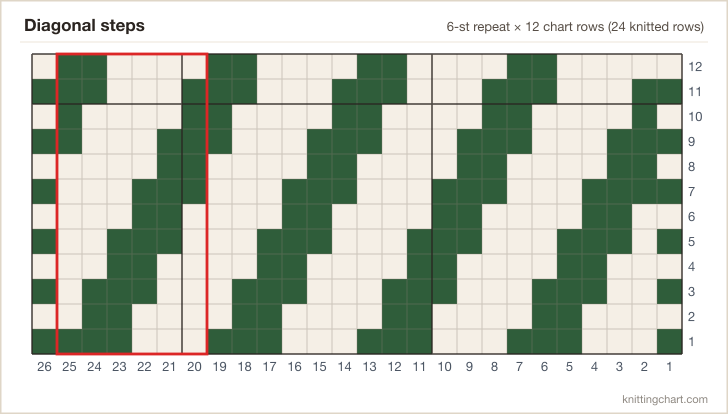
The chart as it is worked; the red box marks one 6-stitch repeat. Row 1 is at the bottom and stitch 1 on the right.
The whole chart in garter-stitch proportions, one chart row as tall as a stitch is wide, so the pattern knits close to the drawing
  • Cast on a multiple of 6 plus 2 edge stitches; the chart is 26 stitches wide (4 repeats plus the edges).
  • 12 chart rows = 24 knitted rows; the longest run of slipped stitches is 3 stitches.
  • At DK, one repeat is about 2.7 × 5.5 cm (1.1 × 2.1 in).

Checked: every slipped stitch sits on its own color and every edge stitch is in the working color (0 problem stitches).

Bold diagonal stripes that rise to the right, for scarves, cowls and blankets.

Written rows (24 rows, both sides)

Read from row 1 at the bottom. Each chart row is two knitted rows, right side then wrong side.

Row 1 (RS) with B: k1, sl3 wyib, k3, sl3 wyib, k3, sl3 wyib, k3, sl3 wyib, k4

Row 2 (WS): k4, sl3 wyif, k3, sl3 wyif, k3, sl3 wyif, k3, sl3 wyif, k1

Row 3 (RS) with A: k4, sl2 wyib, k4, sl2 wyib, k4, sl2 wyib, k4, sl2 wyib, k2

Row 4 (WS): k2, sl2 wyif, k4, sl2 wyif, k4, sl2 wyif, k4, sl2 wyif, k4

Row 5 (RS) with B: k1, sl2 wyib, k3, sl3 wyib, k3, sl3 wyib, k3, sl3 wyib, k3, sl1 wyib, k1

Row 6 (WS): k1, sl1 wyif, k3, sl3 wyif, k3, sl3 wyif, k3, sl3 wyif, k3, sl2 wyif, k1

Row 7 (RS) with A: k3, sl2 wyib, k4, sl2 wyib, k4, sl2 wyib, k4, sl2 wyib, k3

Row 8 (WS): k3, sl2 wyif, k4, sl2 wyif, k4, sl2 wyif, k4, sl2 wyif, k3

Row 9 (RS) with B: k1, sl1 wyib, k3, sl3 wyib, k3, sl3 wyib, k3, sl3 wyib, k3, sl2 wyib, k1

Row 10 (WS): k1, sl2 wyif, k3, sl3 wyif, k3, sl3 wyif, k3, sl3 wyif, k3, sl1 wyif, k1

Row 11 (RS) with A: k2, sl2 wyib, k4, sl2 wyib, k4, sl2 wyib, k4, sl2 wyib, k4

Row 12 (WS): k4, sl2 wyif, k4, sl2 wyif, k4, sl2 wyif, k4, sl2 wyif, k2

Row 13 (RS) with B: k4, sl3 wyib, k3, sl3 wyib, k3, sl3 wyib, k3, sl3 wyib, k1

Row 14 (WS): k1, sl3 wyif, k3, sl3 wyif, k3, sl3 wyif, k3, sl3 wyif, k4

Row 15 (RS) with A: k1, sl2 wyib, k4, sl2 wyib, k4, sl2 wyib, k4, sl2 wyib, k5

Row 16 (WS): k5, sl2 wyif, k4, sl2 wyif, k4, sl2 wyif, k4, sl2 wyif, k1

Row 17 (RS) with B: k3, sl3 wyib, k3, sl3 wyib, k3, sl3 wyib, k3, sl3 wyib, k2

Row 18 (WS): k2, sl3 wyif, k3, sl3 wyif, k3, sl3 wyif, k3, sl3 wyif, k3

Row 19 (RS) with A: k1, sl1 wyib, k4, sl2 wyib, k4, sl2 wyib, k4, sl2 wyib, k4, sl1 wyib, k1

Row 20 (WS): k1, sl1 wyif, k4, sl2 wyif, k4, sl2 wyif, k4, sl2 wyif, k4, sl1 wyif, k1

Row 21 (RS) with B: k2, sl3 wyib, k3, sl3 wyib, k3, sl3 wyib, k3, sl3 wyib, k3

Row 22 (WS): k3, sl3 wyif, k3, sl3 wyif, k3, sl3 wyif, k3, sl3 wyif, k2

Row 23 (RS) with A: k5, sl2 wyib, k4, sl2 wyib, k4, sl2 wyib, k4, sl2 wyib, k1

Row 24 (WS): k1, sl2 wyif, k4, sl2 wyif, k4, sl2 wyif, k4, sl2 wyif, k5

Box chain

Colors: A B

161514131211109876543212625242322212019181716151413121110987654321
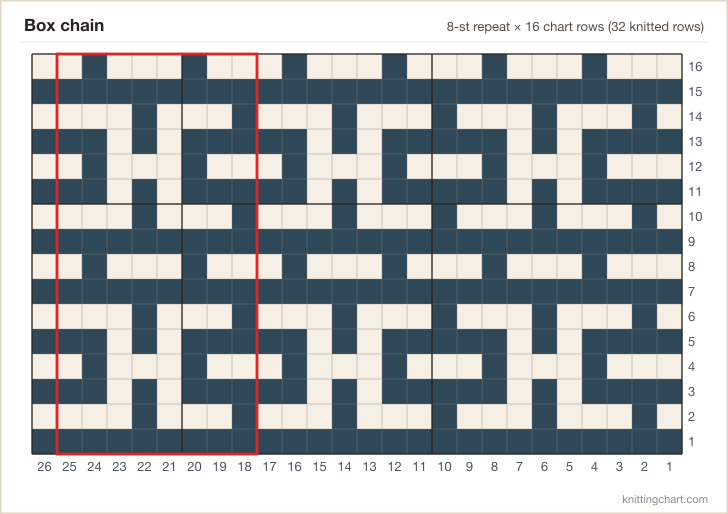
The chart as it is worked; the red box marks one 8-stitch repeat. Row 1 is at the bottom and stitch 1 on the right.
The whole chart in garter-stitch proportions, one chart row as tall as a stitch is wide, so the pattern knits close to the drawing
  • Cast on a multiple of 8 plus 2 edge stitches; the chart is 26 stitches wide (3 repeats plus the edges).
  • 16 chart rows = 32 knitted rows; the longest run of slipped stitches is 1 stitch.
  • At DK, one repeat is about 3.6 × 3.6 cm (1.4 × 1.4 in).

Checked: every slipped stitch sits on its own color and every edge stitch is in the working color (0 problem stitches).

A chain of small boxes between solid dark lines: a border for a blanket edge or a band around a hat.

Written rows (32 rows, both sides)

Read from row 1 at the bottom. Each chart row is two knitted rows, right side then wrong side.

Row 1 (RS) with B: k26

Row 2 (WS): k26

Row 3 (RS) with A: k1, sl1 wyib, k3, sl1 wyib, k3, sl1 wyib, k3, sl1 wyib, k3, sl1 wyib, k3, sl1 wyib, k4

Row 4 (WS): k4, sl1 wyif, k3, sl1 wyif, k3, sl1 wyif, k3, sl1 wyif, k3, sl1 wyif, k3, sl1 wyif, k1

Row 5 (RS) with B: k4, sl1 wyib, k1, sl1 wyib, k5, sl1 wyib, k1, sl1 wyib, k5, sl1 wyib, k1, sl1 wyib, k3

Row 6 (WS): k3, sl1 wyif, k1, sl1 wyif, k5, sl1 wyif, k1, sl1 wyif, k5, sl1 wyif, k1, sl1 wyif, k4

Row 7 (RS) with A: k3, sl1 wyib, k3, sl1 wyib, k3, sl1 wyib, k3, sl1 wyib, k3, sl1 wyib, k3, sl1 wyib, k2

Row 8 (WS): k2, sl1 wyif, k3, sl1 wyif, k3, sl1 wyif, k3, sl1 wyif, k3, sl1 wyif, k3, sl1 wyif, k3

Row 9 (RS) with B: k4, sl1 wyib, k1, sl1 wyib, k5, sl1 wyib, k1, sl1 wyib, k5, sl1 wyib, k1, sl1 wyib, k3

Row 10 (WS): k3, sl1 wyif, k1, sl1 wyif, k5, sl1 wyif, k1, sl1 wyif, k5, sl1 wyif, k1, sl1 wyif, k4

Row 11 (RS) with A: k1, sl1 wyib, k3, sl1 wyib, k3, sl1 wyib, k3, sl1 wyib, k3, sl1 wyib, k3, sl1 wyib, k4

Row 12 (WS): k4, sl1 wyif, k3, sl1 wyif, k3, sl1 wyif, k3, sl1 wyif, k3, sl1 wyif, k3, sl1 wyif, k1

Row 13 (RS) with B: k26

Row 14 (WS): k26

Row 15 (RS) with A: k3, sl1 wyib, k3, sl1 wyib, k3, sl1 wyib, k3, sl1 wyib, k3, sl1 wyib, k3, sl1 wyib, k2

Row 16 (WS): k2, sl1 wyif, k3, sl1 wyif, k3, sl1 wyif, k3, sl1 wyif, k3, sl1 wyif, k3, sl1 wyif, k3

Row 17 (RS) with B: k26

Row 18 (WS): k26

Row 19 (RS) with A: k1, sl1 wyib, k3, sl1 wyib, k3, sl1 wyib, k3, sl1 wyib, k3, sl1 wyib, k3, sl1 wyib, k4

Row 20 (WS): k4, sl1 wyif, k3, sl1 wyif, k3, sl1 wyif, k3, sl1 wyif, k3, sl1 wyif, k3, sl1 wyif, k1

Row 21 (RS) with B: k4, sl1 wyib, k1, sl1 wyib, k5, sl1 wyib, k1, sl1 wyib, k5, sl1 wyib, k1, sl1 wyib, k3

Row 22 (WS): k3, sl1 wyif, k1, sl1 wyif, k5, sl1 wyif, k1, sl1 wyif, k5, sl1 wyif, k1, sl1 wyif, k4

Row 23 (RS) with A: k3, sl1 wyib, k3, sl1 wyib, k3, sl1 wyib, k3, sl1 wyib, k3, sl1 wyib, k3, sl1 wyib, k2

Row 24 (WS): k2, sl1 wyif, k3, sl1 wyif, k3, sl1 wyif, k3, sl1 wyif, k3, sl1 wyif, k3, sl1 wyif, k3

Row 25 (RS) with B: k4, sl1 wyib, k1, sl1 wyib, k5, sl1 wyib, k1, sl1 wyib, k5, sl1 wyib, k1, sl1 wyib, k3

Row 26 (WS): k3, sl1 wyif, k1, sl1 wyif, k5, sl1 wyif, k1, sl1 wyif, k5, sl1 wyif, k1, sl1 wyif, k4

Row 27 (RS) with A: k1, sl1 wyib, k3, sl1 wyib, k3, sl1 wyib, k3, sl1 wyib, k3, sl1 wyib, k3, sl1 wyib, k4

Row 28 (WS): k4, sl1 wyif, k3, sl1 wyif, k3, sl1 wyif, k3, sl1 wyif, k3, sl1 wyif, k3, sl1 wyif, k1

Row 29 (RS) with B: k26

Row 30 (WS): k26

Row 31 (RS) with A: k3, sl1 wyib, k3, sl1 wyib, k3, sl1 wyib, k3, sl1 wyib, k3, sl1 wyib, k3, sl1 wyib, k2

Row 32 (WS): k2, sl1 wyif, k3, sl1 wyif, k3, sl1 wyif, k3, sl1 wyif, k3, sl1 wyif, k3, sl1 wyif, k3

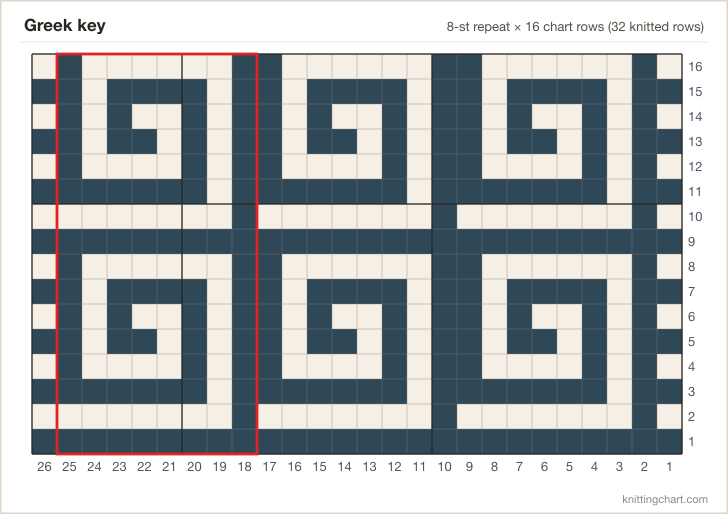
Greek key

Colors: A B

161514131211109876543212625242322212019181716151413121110987654321
The chart as it is worked; the red box marks one 8-stitch repeat. Row 1 is at the bottom and stitch 1 on the right.
The whole chart in garter-stitch proportions, one chart row as tall as a stitch is wide, so the pattern knits close to the drawing
  • Cast on a multiple of 8 plus 2 edge stitches; the chart is 26 stitches wide (3 repeats plus the edges).
  • 16 chart rows = 32 knitted rows; the longest run of slipped stitches is 2 stitches.
  • At DK, one repeat is about 3.6 × 3.6 cm (1.4 × 1.4 in).

Checked: every slipped stitch sits on its own color and every edge stitch is in the working color (0 problem stitches).

The classic meander: spirals side by side with a solid dark bar between them. A border for a blanket, a cushion or a bag.

Written rows (32 rows, both sides)

Read from row 1 at the bottom. Each chart row is two knitted rows, right side then wrong side.

Row 1 (RS) with B: k26

Row 2 (WS): k26

Row 3 (RS) with A: k1, sl1 wyib, k7, sl1 wyib, k7, sl1 wyib, k8

Row 4 (WS): k8, sl1 wyif, k7, sl1 wyif, k7, sl1 wyif, k1

Row 5 (RS) with B: k2, sl1 wyib, k7, sl1 wyib, k7, sl1 wyib, k7

Row 6 (WS): k7, sl1 wyif, k7, sl1 wyif, k7, sl1 wyif, k2

Row 7 (RS) with A: k1, sl1 wyib, k1, sl1 wyib, k4, sl2 wyib, k1, sl1 wyib, k4, sl2 wyib, k1, sl1 wyib, k4, sl1 wyib, k1

Row 8 (WS): k1, sl1 wyif, k4, sl1 wyif, k1, sl2 wyif, k4, sl1 wyif, k1, sl2 wyif, k4, sl1 wyif, k1, sl1 wyif, k1

Row 9 (RS) with B: k2, sl1 wyib, k1, sl1 wyib, k2, sl1 wyib, k2, sl1 wyib, k1, sl1 wyib, k2, sl1 wyib, k2, sl1 wyib, k1, sl1 wyib, k2, sl1 wyib, k2

Row 10 (WS): k2, sl1 wyif, k2, sl1 wyif, k1, sl1 wyif, k2, sl1 wyif, k2, sl1 wyif, k1, sl1 wyif, k2, sl1 wyif, k2, sl1 wyif, k1, sl1 wyif, k2

Row 11 (RS) with A: k1, sl1 wyib, k1, sl1 wyib, k2, sl1 wyib, k1, sl2 wyib, k1, sl1 wyib, k2, sl1 wyib, k1, sl2 wyib, k1, sl1 wyib, k2, sl1 wyib, k1, sl1 wyib, k1

Row 12 (WS): k1, sl1 wyif, k1, sl1 wyif, k2, sl1 wyif, k1, sl2 wyif, k1, sl1 wyif, k2, sl1 wyif, k1, sl2 wyif, k1, sl1 wyif, k2, sl1 wyif, k1, sl1 wyif, k1

Row 13 (RS) with B: k2, sl1 wyib, k4, sl1 wyib, k2, sl1 wyib, k4, sl1 wyib, k2, sl1 wyib, k4, sl1 wyib, k2

Row 14 (WS): k2, sl1 wyif, k4, sl1 wyif, k2, sl1 wyif, k4, sl1 wyif, k2, sl1 wyif, k4, sl1 wyif, k2

Row 15 (RS) with A: k1, sl1 wyib, k6, sl2 wyib, k6, sl2 wyib, k6, sl1 wyib, k1

Row 16 (WS): k1, sl1 wyif, k6, sl2 wyif, k6, sl2 wyif, k6, sl1 wyif, k1

Row 17 (RS) with B: k26

Row 18 (WS): k26

Row 19 (RS) with A: k1, sl1 wyib, k7, sl1 wyib, k7, sl1 wyib, k8

Row 20 (WS): k8, sl1 wyif, k7, sl1 wyif, k7, sl1 wyif, k1

Row 21 (RS) with B: k2, sl1 wyib, k7, sl1 wyib, k7, sl1 wyib, k7

Row 22 (WS): k7, sl1 wyif, k7, sl1 wyif, k7, sl1 wyif, k2

Row 23 (RS) with A: k1, sl1 wyib, k1, sl1 wyib, k4, sl2 wyib, k1, sl1 wyib, k4, sl2 wyib, k1, sl1 wyib, k4, sl1 wyib, k1

Row 24 (WS): k1, sl1 wyif, k4, sl1 wyif, k1, sl2 wyif, k4, sl1 wyif, k1, sl2 wyif, k4, sl1 wyif, k1, sl1 wyif, k1

Row 25 (RS) with B: k2, sl1 wyib, k1, sl1 wyib, k2, sl1 wyib, k2, sl1 wyib, k1, sl1 wyib, k2, sl1 wyib, k2, sl1 wyib, k1, sl1 wyib, k2, sl1 wyib, k2

Row 26 (WS): k2, sl1 wyif, k2, sl1 wyif, k1, sl1 wyif, k2, sl1 wyif, k2, sl1 wyif, k1, sl1 wyif, k2, sl1 wyif, k2, sl1 wyif, k1, sl1 wyif, k2

Row 27 (RS) with A: k1, sl1 wyib, k1, sl1 wyib, k2, sl1 wyib, k1, sl2 wyib, k1, sl1 wyib, k2, sl1 wyib, k1, sl2 wyib, k1, sl1 wyib, k2, sl1 wyib, k1, sl1 wyib, k1

Row 28 (WS): k1, sl1 wyif, k1, sl1 wyif, k2, sl1 wyif, k1, sl2 wyif, k1, sl1 wyif, k2, sl1 wyif, k1, sl2 wyif, k1, sl1 wyif, k2, sl1 wyif, k1, sl1 wyif, k1

Row 29 (RS) with B: k2, sl1 wyib, k4, sl1 wyib, k2, sl1 wyib, k4, sl1 wyib, k2, sl1 wyib, k4, sl1 wyib, k2

Row 30 (WS): k2, sl1 wyif, k4, sl1 wyif, k2, sl1 wyif, k4, sl1 wyif, k2, sl1 wyif, k4, sl1 wyif, k2

Row 31 (RS) with A: k1, sl1 wyib, k6, sl2 wyib, k6, sl2 wyib, k6, sl1 wyib, k1

Row 32 (WS): k1, sl1 wyif, k6, sl2 wyif, k6, sl2 wyif, k6, sl1 wyif, k1

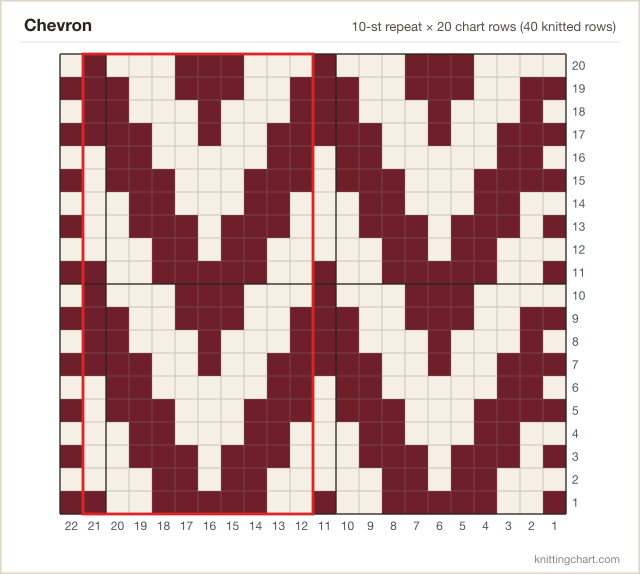
Chevron

Colors: A B

201918171615141312111098765432122212019181716151413121110987654321
The chart as it is worked; the red box marks one 10-stitch repeat. Row 1 is at the bottom and stitch 1 on the right.
The whole chart in garter-stitch proportions, one chart row as tall as a stitch is wide, so the pattern knits close to the drawing
  • Cast on a multiple of 10 plus 2 edge stitches; the chart is 22 stitches wide (2 repeats plus the edges).
  • 20 chart rows = 40 knitted rows; the longest run of slipped stitches is 3 stitches.
  • At DK, one repeat is about 4.5 × 4.5 cm (1.8 × 1.8 in).

Checked: every slipped stitch sits on its own color and every edge stitch is in the working color (0 problem stitches).

Zigzag bands whose points stack up the fabric, for blankets and scarves.

Written rows (40 rows, both sides)

Read from row 1 at the bottom. Each chart row is two knitted rows, right side then wrong side.

Row 1 (RS) with B: k1, sl2 wyib, k5, sl2 wyib, k1, sl2 wyib, k5, sl2 wyib, k2

Row 2 (WS): k2, sl2 wyif, k5, sl2 wyif, k1, sl2 wyif, k5, sl2 wyif, k1

Row 3 (RS) with A: k3, sl2 wyib, k1, sl2 wyib, k5, sl2 wyib, k1, sl2 wyib, k4

Row 4 (WS): k4, sl2 wyif, k1, sl2 wyif, k5, sl2 wyif, k1, sl2 wyif, k3

Row 5 (RS) with B: k1, sl1 wyib, k3, sl1 wyib, k3, sl3 wyib, k3, sl1 wyib, k3, sl2 wyib, k1

Row 6 (WS): k1, sl2 wyif, k3, sl1 wyif, k3, sl3 wyif, k3, sl1 wyif, k3, sl1 wyif, k1

Row 7 (RS) with A: k2, sl2 wyib, k3, sl2 wyib, k3, sl2 wyib, k3, sl2 wyib, k3

Row 8 (WS): k3, sl2 wyif, k3, sl2 wyif, k3, sl2 wyif, k3, sl2 wyif, k2

Row 9 (RS) with B: k4, sl3 wyib, k3, sl1 wyib, k3, sl3 wyib, k3, sl1 wyib, k1

Row 10 (WS): k1, sl1 wyif, k3, sl3 wyif, k3, sl1 wyif, k3, sl3 wyif, k4

Row 11 (RS) with A: k1, sl2 wyib, k5, sl2 wyib, k1, sl2 wyib, k5, sl2 wyib, k2

Row 12 (WS): k2, sl2 wyif, k5, sl2 wyif, k1, sl2 wyif, k5, sl2 wyif, k1

Row 13 (RS) with B: k3, sl2 wyib, k1, sl2 wyib, k5, sl2 wyib, k1, sl2 wyib, k4

Row 14 (WS): k4, sl2 wyif, k1, sl2 wyif, k5, sl2 wyif, k1, sl2 wyif, k3

Row 15 (RS) with A: k1, sl1 wyib, k3, sl1 wyib, k3, sl3 wyib, k3, sl1 wyib, k3, sl2 wyib, k1

Row 16 (WS): k1, sl2 wyif, k3, sl1 wyif, k3, sl3 wyif, k3, sl1 wyif, k3, sl1 wyif, k1

Row 17 (RS) with B: k2, sl2 wyib, k3, sl2 wyib, k3, sl2 wyib, k3, sl2 wyib, k3

Row 18 (WS): k3, sl2 wyif, k3, sl2 wyif, k3, sl2 wyif, k3, sl2 wyif, k2

Row 19 (RS) with A: k4, sl3 wyib, k3, sl1 wyib, k3, sl3 wyib, k3, sl1 wyib, k1

Row 20 (WS): k1, sl1 wyif, k3, sl3 wyif, k3, sl1 wyif, k3, sl3 wyif, k4

Row 21 (RS) with B: k1, sl2 wyib, k5, sl2 wyib, k1, sl2 wyib, k5, sl2 wyib, k2

Row 22 (WS): k2, sl2 wyif, k5, sl2 wyif, k1, sl2 wyif, k5, sl2 wyif, k1

Row 23 (RS) with A: k3, sl2 wyib, k1, sl2 wyib, k5, sl2 wyib, k1, sl2 wyib, k4

Row 24 (WS): k4, sl2 wyif, k1, sl2 wyif, k5, sl2 wyif, k1, sl2 wyif, k3

Row 25 (RS) with B: k1, sl1 wyib, k3, sl1 wyib, k3, sl3 wyib, k3, sl1 wyib, k3, sl2 wyib, k1

Row 26 (WS): k1, sl2 wyif, k3, sl1 wyif, k3, sl3 wyif, k3, sl1 wyif, k3, sl1 wyif, k1

Row 27 (RS) with A: k2, sl2 wyib, k3, sl2 wyib, k3, sl2 wyib, k3, sl2 wyib, k3

Row 28 (WS): k3, sl2 wyif, k3, sl2 wyif, k3, sl2 wyif, k3, sl2 wyif, k2

Row 29 (RS) with B: k4, sl3 wyib, k3, sl1 wyib, k3, sl3 wyib, k3, sl1 wyib, k1

Row 30 (WS): k1, sl1 wyif, k3, sl3 wyif, k3, sl1 wyif, k3, sl3 wyif, k4

Row 31 (RS) with A: k1, sl2 wyib, k5, sl2 wyib, k1, sl2 wyib, k5, sl2 wyib, k2

Row 32 (WS): k2, sl2 wyif, k5, sl2 wyif, k1, sl2 wyif, k5, sl2 wyif, k1

Row 33 (RS) with B: k3, sl2 wyib, k1, sl2 wyib, k5, sl2 wyib, k1, sl2 wyib, k4

Row 34 (WS): k4, sl2 wyif, k1, sl2 wyif, k5, sl2 wyif, k1, sl2 wyif, k3

Row 35 (RS) with A: k1, sl1 wyib, k3, sl1 wyib, k3, sl3 wyib, k3, sl1 wyib, k3, sl2 wyib, k1

Row 36 (WS): k1, sl2 wyif, k3, sl1 wyif, k3, sl3 wyif, k3, sl1 wyif, k3, sl1 wyif, k1

Row 37 (RS) with B: k2, sl2 wyib, k3, sl2 wyib, k3, sl2 wyib, k3, sl2 wyib, k3

Row 38 (WS): k3, sl2 wyif, k3, sl2 wyif, k3, sl2 wyif, k3, sl2 wyif, k2

Row 39 (RS) with A: k4, sl3 wyib, k3, sl1 wyib, k3, sl3 wyib, k3, sl1 wyib, k1

Row 40 (WS): k1, sl1 wyif, k3, sl3 wyif, k3, sl1 wyif, k3, sl3 wyif, k4

Every chart row starts with a right-side row, so read each one from right to left (that is why all the row numbers sit on the right), then work back over the same stitches on the wrong side. Each chart row is two knitted rows, so the 12 to 20 chart rows on these cards are 24 to 40 knitted rows. The free Fair Isle charts use two colors in the same row instead; these use one color at a time.

How to knit a mosaic chart

Cast on with A

With A, cast on a multiple of the repeat plus 2 edge stitches: for the Slip-stitch tweed that is a multiple of 4 plus 2, which is 22 stitches for the chart as drawn. Work one wrong-side row in A as the foundation row, then turn: chart row 1 is a right-side row.

Work chart row 1 with B

Odd chart rows are worked with B and even chart rows with A. On the right side, knit every stitch shown in the working color and slip every stitch shown in the other color purlwise with the yarn in back (wyib). The first and last stitch of the row are edge stitches, so they are always knitted in the working color.

Work the wrong side back

Turn and work the same stitches: knit the stitches you knitted (purl them if you are working stockinette) and slip the stitches you slipped with the yarn in front (wyif). This row is not a new chart row; it is the second half of chart row 1.

Change color every two rows

A chart row is two knitted rows, one right side and one wrong side, so change color every two rows. Carry the yarn you are not using up the side of the work and do not cut it. Every slipped stitch sits on a stitch of its own color, which is what draws the pattern.

The mosaic rule, and how these charts were checked

A slipped stitch carries the color of the row below it up into the new row, and that is what draws a mosaic pattern. It also sets the rule every chart has to keep: on any chart row, a square in the color that is not working is a slipped stitch, so the square directly below it must be the same color. If it were the other color, the slip would show the wrong color and break the pattern. The first and last stitch of every row are edge stitches, always knitted in the working color, and when a chart is repeated the bottom row sits on the top row of the next repeat.

All 6 charts were checked square by square: 0 problem stitches in 2,200 squares. The table gives the count for each chart, next to its repeat, its chart row count and the longest run of slipped stitches in a row. Row 1 is at the bottom and stitch 1 on the right; every chart row is read from right to left on its right-side row and worked back on the wrong side, and the guide to reading a knitting chart explains the numbering.

ChartRepeatChart rowsLongest slipProblem stitches
Slip-stitch tweed4 sts12 (24 knitted rows)10
Windowpane4 sts16 (32 knitted rows)20
Diagonal steps6 sts12 (24 knitted rows)30
Box chain8 sts16 (32 knitted rows)10
Greek key8 sts16 (32 knitted rows)20
Chevron10 sts20 (40 knitted rows)30

Mosaic is not the only way to put two colors in a fabric. The Fair Isle charts carry both yarns across the same row; mosaic works one color per row and lets the slipped stitches do the drawing.

Garter or stockinette

A mosaic chart can be knitted in garter or in stockinette. In garter the wrong-side row is knitted, so one chart row (two knitted rows) makes one ridge, and a ridge is about as tall as a stitch is wide. The charts are drawn on that square grid, one square per stitch and one square per chart row, so the picture matches the fabric.

In stockinette the wrong-side row is purled, which gives a smoother surface, but the row height changes. At the DK gauge of 22 stitches and 30 rows per 10 cm, one stitch is about 0.45 cm wide and one chart row (two knitted rows) is 0.67 cm tall, which is 1.47 times the stitch width. A square motif knitted in stockinette therefore comes out about 1.47 times taller than it is wide: the pattern is stretched vertically. Swatch first — knit a small square in the yarn and stitch pattern you plan to use and measure it — then choose garter if you want the charted shape, or stockinette if you want the smooth surface and accept the taller motif.

Sizes at three yarn weights

The table gives one repeat of each chart at the gauges used on this site ( Fingering, DK and Worsted), in centimeters and inches; the sizes are approximate. It counts a chart row as one stitch wide, because in garter one chart row (one ridge) is about as tall as a stitch is wide; that is the same proportion the charts are drawn in. Width is the repeat times the stitch width, and height is the repeat's chart rows times the same stitch width.

ChartRepeatFingering 28 sts per 10 cmDK 22 sts per 10 cmWorsted 18 sts per 10 cm
Slip-stitch tweed4 sts × 4 chart rows1.4 × 1.4 cm (0.6 × 0.6 in)1.8 × 1.8 cm (0.7 × 0.7 in)2.2 × 2.2 cm (0.9 × 0.9 in)
Windowpane4 sts × 8 chart rows1.4 × 2.9 cm (0.6 × 1.1 in)1.8 × 3.6 cm (0.7 × 1.4 in)2.2 × 4.4 cm (0.9 × 1.7 in)
Diagonal steps6 sts × 12 chart rows2.1 × 4.3 cm (0.8 × 1.7 in)2.7 × 5.5 cm (1.1 × 2.1 in)3.3 × 6.7 cm (1.3 × 2.6 in)
Box chain8 sts × 8 chart rows2.9 × 2.9 cm (1.1 × 1.1 in)3.6 × 3.6 cm (1.4 × 1.4 in)4.4 × 4.4 cm (1.7 × 1.7 in)
Greek key8 sts × 8 chart rows2.9 × 2.9 cm (1.1 × 1.1 in)3.6 × 3.6 cm (1.4 × 1.4 in)4.4 × 4.4 cm (1.7 × 1.7 in)
Chevron10 sts × 10 chart rows3.6 × 3.6 cm (1.4 × 1.4 in)4.5 × 4.5 cm (1.8 × 1.8 in)5.6 × 5.6 cm (2.2 × 2.2 in)

At DK a repeat runs from 1.8 to 4.5 cm wide and 1.8 to 5.5 cm tall, so a larger piece is made by repeating it: cast on enough repeats for the width you want, plus the 2 edge stitches when you work flat. A finer yarn makes the same repeat smaller and a thicker yarn makes it larger, while the stitch and chart row counts stay the same.

Which chart to start with

Ranked by the longest run of slipped stitches first, then by the shortest repeat, then by the fewest chart rows, the Slip-stitch tweed comes first: its longest run is 1 slipped stitch in a row, its repeat is 4 stitches, and one repeat is 4 chart rows. The chart on its card is 22 stitches by 12 chart rows — 5 repeats across and 3 up, 24 knitted rows — and one repeat is about 1.8 × 1.8 cm at DK. That gives you the fewest slipped stitches to keep track of while you learn the rhythm of one color per row.

The other 5 charts wait until that rhythm is automatic; the Fair Isle charts are the next step if you want two colors moving at once.

Mosaic in the round

Worked in the round, each chart row becomes two rounds, and both are right-side rounds read from right to left. Knit the stitches of the working color and slip the others purlwise with the yarn on the wrong side, which is the inside of the tube (in back). There are no edge stitches, so leave out the two edge columns of the flat charts and cast on a multiple of the repeat — 4 to 10 stitches here. Stockinette is the simplest choice: every round is knitted, and only the color changes.

Draw your own mosaic chart

Draw the pattern in two colors, then check it against the rule above before you knit: every square in the color that is not working needs the same color directly below it, and the first and last stitch of every row stays in the working color. You can draw it in the free chart editor, or work it out on knitting graph paper printed at your gauge. The editor draws and prints the colors but does not check the mosaic rule for you, so run that check yourself.

Individual mosaic chart images

Garter-proportioned numbered grids with the single pattern repeat outlined in red for each mosaic design.

Slip-stitch tweed slip-stitch mosaic knitting chart: 22 stitches wide (4-stitch repeat marked in red) by 12 chart rows, max 1 slipped stitch
Slip-stitch tweed — 4-st repeat, 12 chart rows (24 knitted rows)
Windowpane slip-stitch mosaic knitting chart: 22 stitches wide (4-stitch repeat marked in red) by 16 chart rows, max 2 slipped stitches
Windowpane — 4-st repeat, 16 chart rows (32 knitted rows)
Diagonal steps slip-stitch mosaic knitting chart: 26 stitches wide (6-stitch repeat marked in red) by 12 chart rows, max 3 slipped stitches
Diagonal steps — 6-st repeat, 12 chart rows (24 knitted rows)
Box chain slip-stitch mosaic knitting chart: 26 stitches wide (8-stitch repeat marked in red) by 16 chart rows, max 1 slipped stitch
Box chain — 8-st repeat, 16 chart rows (32 knitted rows)
Greek key slip-stitch mosaic knitting chart: 26 stitches wide (8-stitch repeat marked in red) by 16 chart rows, max 2 slipped stitches
Greek key — 8-st repeat, 16 chart rows (32 knitted rows)
Chevron slip-stitch mosaic knitting chart: 22 stitches wide (10-stitch repeat marked in red) by 20 chart rows, max 3 slipped stitches
Chevron — 10-st repeat, 20 chart rows (40 knitted rows)

Free does a lot. Pro keeps it with you.

Every chart on this page is free to download, customize and knit. Pro is for keeping your charts and your place in them on every device.

What you getFreein this browserProabout $2 a month
Charts saved in your account — safe if you clear your browserNot included Included
Open and edit the same charts on computer, phone and tabletNot included Included
Select, copy, cut, paste, move, rotate and flip; fill a box with repeats; find and replace; mirror, flip or rotate the whole chartSelecting and copying free; changes 3 a dayUnlimited
PDF with color key and written instructions, no watermark1 a dayUnlimited
Pattern document to publish or sell: several charts in one PDF with your cover, logo, copyright line, materials and the yarn they takeTry in the preview Included
My stitch library: your own stitches ready in every chart, on every device, saved to a file to shareNot included Included
My tiles: save a selected motif, border or repeat and place it in any chart, on every deviceNot included Included
Knit mode: follow a chart you drew row by row, with counters and notes1 chart at a time, in this browserUnlimited, kept in your account
Follow a PDF pattern with a row highlighterOn screen; your place is not kept (10 MB each)Unlimited, at the row you stopped, kept in your account (10 MB each, 200 MB in all)
Your place, counters and notes on every deviceNot included Included
Mark your chart or PDF: highlighter, boxes, sticky notes, one color per symbolTry on screenKept with the project, on every device
PNG with color key, and written instructions row by row, no watermark Included Included
See Pro $3.99 a month or $24 a year, renews until you cancel · or was $59 $40.12 once for lifetime Black Friday −32% until Nov 30$3.99 a month or $24 a year, renews until you cancel · or $59 once for lifetime. 14-day money-back.

Questions about mosaic knitting charts

Are these mosaic knitting charts free, and is there a PDF?

Yes. All 6 charts are free to knit, change and print, with no sign-up and no watermark. Download all 6 as one PDF, or open any card in the free chart editor. You can knit them, change them and use them in your own projects and patterns.

Can I make my own mosaic knitting chart?

Yes. Draw it in the free chart editor in two colors, then check it against the mosaic rule before you knit: every square in the color that is not working needs the same color directly below it, and the first and last stitch of every row has to be in the working color. The editor draws and prints the colors but does not test the mosaic rule for you, so that check is by eye. On paper, print knitting graph paper at your gauge instead.

What is the easiest mosaic knitting pattern for beginners?

The Slip-stitch tweed. Ranked by the longest run of slipped stitches first, then by the shortest repeat, then by the fewest chart rows, it comes first: 1 slip in a row at most, a 4-stitch repeat and 4 chart rows per repeat. Its card has the written rows for both sides; cast on a multiple of 4 plus 2 and start at chart row 1 at the bottom.

How do you read a mosaic knitting chart?

Start at the bottom right: chart row 1 is a right-side row and stitch 1 is the right edge. Read each chart row from right to left on the right side, then work back across the same stitches from left to right on the wrong side, so every chart row is used twice, once for each of its two knitted rows. Odd chart rows are worked with B and even rows with A. The guide to reading a knitting chart explains row and stitch numbering in full.

Do you work each chart row twice?

Yes. Each chart row is one right-side row and the wrong-side row back over the same stitches, so the 12 to 20 chart rows on these cards are 24 to 40 knitted rows. On the wrong side, knit the stitches you knitted (purl them in stockinette) and slip the slipped stitches with the yarn in front.

How many stitches do I cast on for a mosaic chart?

Cast on a multiple of the repeat plus 2 edge stitches. The repeats here run from 4 to 10 stitches, so pick the multiple you need and add 2. For the Slip-stitch tweed, use a multiple of 4 plus 2; the chart as drawn is 22 stitches, which is 5 repeats plus the two edges.

Can you do mosaic knitting in the round?

Yes. Work each chart row as two rounds, both read from right to left, and slip the stitches of the other color purlwise with the yarn on the wrong side (in back). There are no edge stitches in the round, so cast on a multiple of the repeat; stockinette is the simplest, with every round knitted.

Is mosaic knitting easier than Fair Isle?

In one way, yes: every row uses a single color, so you never hold two yarns at once, and the strand left behind the work never runs longer than 3 stitches on any of these charts. Fair Isle uses two colors in the same row, which makes larger multicolor motifs possible but means carrying both yarns; the free Fair Isle charts show how that works.