Draw a lace knitting chart online, for free and with no download: yarn overs, 56 decreases from k2tog and ssk to centered double decreases, nupps and no-stitch squares. A row whose yarn overs and decreases do not add up turns red as you draw, every written row ends with its stitch count, and the printable PDF comes with a symbol key that says how to work each stitch on both sides.
Enter the stitches and rows of one repeat plus any edge stitches, and choose “Worked: Flat” for a shawl or scarf, or “In the round” for a hat or sock.
Pair each yarn over with a decrease
Open the Lace shelf and draw a yarn over where you want a hole, then the decrease that takes the stitch away again: k2tog leans right, ssk leans left, s2kp stands straight up.
Use no-stitch squares for shaping
Where the stitch count grows or shrinks across the chart, fill the squares that have no stitch yet with the gray no-stitch symbol so the columns stay lined up.
Check the counts and download
A row that does not work the stitches the row below made turns red on the chart, with why and how to fix it underneath; a yarn over without its decrease is the usual cause. Then download the free PDF with chart, key and written rows.
Lace chart examples to start from
Three classic lace patterns, each checked so every row works exactly the stitches the row below made. Open one in the editor to repeat it across a shawl or change it, or knit it row by row in the pattern tracker.
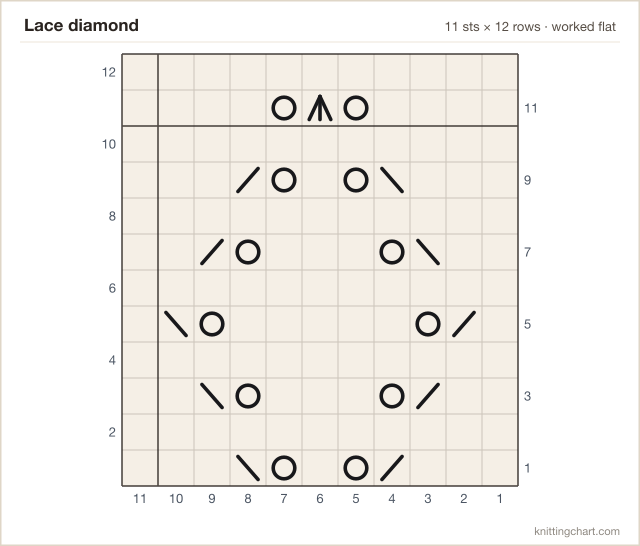
Lace diamond
Yarn overs open a diamond and paired decreases keep the stitch count: each yarn over sits next to the k2tog or ssk that takes its stitch away again.11 stitches × 12 rows, worked flat. Row 1 is at the bottom; right-side rows are read from right to left.
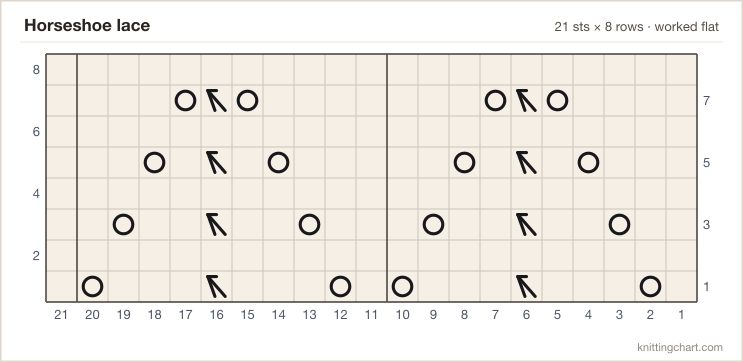
A classic 10-stitch repeat: two yarn overs drift toward a centered double decrease row by row, drawing a horseshoe. Wrong-side rows are purled.21 stitches × 8 rows, worked flat. Row 1 is at the bottom; right-side rows are read from right to left.
k
yo
sk2p
Written rows (8)
Row 1 (RS): k1, *yo, k3, sk2p, k3, yo, k1; rep from * to end. (21 sts)
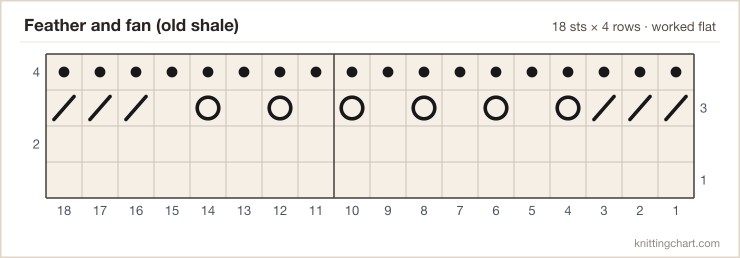
An 18-stitch scallop from a Shetland tradition: three decreases on each side, six yarn overs in the middle, and a knit wrong-side row that makes the ridge.18 stitches × 4 rows, worked flat. Row 1 is at the bottom; right-side rows are read from right to left.
k
p
yo
k2tog
Written rows (4)
Row 1 (RS): k18. (18 sts)
Row 2 (WS): p18. (18 sts)
Row 3 (RS): k2tog 3 times, *yo, k1; rep from * to last 6 sts, k2tog 3 times. (18 sts)
Row 4 (WS): k18. (18 sts)
How to read a lace knitting chart
A lace chart is read like any other: row 1 at the bottom, right-side rows from right to left, wrong-side rows from left to right. What makes lace different is that the symbols change the number of stitches.
A circle is a yarn over. It adds a stitch and leaves a hole.
A slanted line is a decrease that leans the same way: / is k2tog (right), \ is ssk (left). Most yarn overs have a decrease right next to them, so the count stays the same.
Three lines meeting at the top are a double decrease: three stitches become one. The upward arrow, s2kp, keeps the middle stitch on top; k3tog leans right and sk2p and sssk lean left.
A gray square is no stitch. Skip it and go on to the next square. It holds a place where a stitch will be added later or has been decreased away.
Many printed lace charts show only the right-side rows, with a note to purl every wrong-side row. A chart drawn here shows every row, so the wrong-side rows are written out as “p11” and you never have to remember the rule. If a row you knit ends with a different count from the chart, look for a yarn over you missed or a decrease worked as a plain knit. More in how to read a knitting chart.
Lace with cables and texture
Lace symbols share the chart with every other stitch: a cable between lace panels, purl ridges as in feather and fan, or twisted stitches to outline a leaf. The cable knitting chart maker covers cables, and the knitting chart symbols page lists all 501.
The symbols most lace charts are made of, with what to work on right-side (RS) and wrong-side (WS) rows. They follow the Craft Yarn Council’s conventions.
Knit
RS: k · WS: p
Knit on right-side rows, purl on wrong-side rows. Shown as an empty square.
Purl
RS: p · WS: k
Purl on right-side rows, knit on wrong-side rows.
Yarn over
RS: yo · WS: yo · 0 → 1 sts
Wrap the yarn over the needle to make a new stitch and an eyelet.
Knit 2 together
RS: k2tog · WS: p2tog · 2 → 1 sts
Decrease that leans right: knit 2 stitches together (purl 2 together on wrong-side rows).
Slip, slip, knit
RS: ssk · WS: ssp · 2 → 1 sts
Decrease that leans left: slip 2 stitches knitwise one at a time, then knit them together through the back loops (ssp on wrong-side rows).
Slip, knit, pass over
RS: skp · WS: ssp · 2 → 1 sts
Decrease that leans left: slip 1 knitwise, knit 1, pass the slipped stitch over.
Slip 1, knit 2 together, pass over
RS: sk2p · WS: p3tog tbl · 3 → 1 sts
Double decrease that leans left: slip 1 knitwise, knit 2 together, pass the slipped stitch over (also written sl1-k2tog-psso).
Centered double decrease (also cdd, sl2-k1-p2sso)
RS: s2kp · WS: s2pp · 3 → 1 sts
Double decrease that does not lean: slip 2 together knitwise, knit 1, pass the 2 slipped stitches over. The center stitch stays on top.
Knit 3 together
RS: k3tog · WS: p3tog · 3 → 1 sts
Double decrease that leans right: knit 3 stitches together.
Slip, slip, slip, knit
RS: sssk · WS: sssp · 3 → 1 sts
Double decrease that leans left: slip 3 stitches knitwise one at a time, then knit them together through the back loops.
No stitch
No stitch on either side
Placeholder where a stitch does not exist yet (or any more). Skip it.
More lace stitches (32)
Double yarn overs, purl-side decreases, nupps and beads, and the wide decreases used in leaf and shell patterns. The chart maker has 13 yarn overs and 56 decreases in all.
Double yarn over
RS: yo twice · WS: yo twice · 0 → 2 sts
Wrap the yarn 2 times around the needle for a big eyelet. On the next row work the wraps as 2 stitches (knit 1, purl 1 …).
Yarn over 3 times
RS: yo 3 times · WS: yo 3 times · 0 → 3 sts
Wrap the yarn 3 times around the needle for a big eyelet. On the next row work the wraps as 3 stitches (knit 1, purl 1 …).
Purl 2 together
RS: p2tog · WS: k2tog · 2 → 1 sts
Purl 2 stitches together (knit 2 together on wrong-side rows). Leans right on the knit side.
Slip, slip, purl
RS: ssp · WS: ssk · 2 → 1 sts
Slip 2 knitwise one at a time, return them to the left needle and purl them together through the back loops. Leans left on the knit side.
Purl 3 together
RS: p3tog · WS: k3tog · 3 → 1 sts
Purl 3 stitches together.
Knit through back loop
RS: k1 tbl · WS: p1 tbl
Twisted stitch: knit through the back loop (purl through the back loop on wrong-side rows).
Knit 2 together through back loops
RS: k2tog tbl · WS: p2tog tbl · 2 → 1 sts
Decrease that leans left with twisted stitches: knit 2 together through the back loops.
5-loop nupp
RS: nupp5 · WS: nupp5
Estonian nupp: work (k1, yo) loosely into the same stitch until there are 5 loops; on the next row purl all 5 loops together.
7-loop nupp
RS: nupp7 · WS: nupp7
Estonian nupp: work (k1, yo) loosely into the same stitch until there are 7 loops; on the next row purl all 7 loops together.
Knit with bead slid up
RS: k1 bead · WS: p1 bead
Slide a pre-strung bead up close to the needle and knit the stitch so the bead sits in front.
Yes. This lace knitting chart maker is free and runs in the browser, with yarn overs, 56 decreases, nupps and no-stitch squares, and a free PDF with key and written rows. Nothing to download or sign up for.
What does the circle mean on a lace chart?
A yarn over: bring the yarn over the needle to make a new stitch with a hole under it. On wrong-side rows you work it as an ordinary stitch.
Why does my lace row have the wrong number of stitches?
Usually a yarn over was dropped or a decrease was knitted as a plain stitch. Compare your count with the count at the end of that row in the written instructions; the row where they first differ is where to look. If the chart itself is off, the chart maker marks that row red and says which stitches are missing their pair.
What does a gray square mean in a lace chart?
No stitch. That square has no stitch on the needle, so skip it. It keeps the columns lined up where the stitch count changes, for example at the edge of a triangle shawl.
Do I purl the wrong-side rows of a lace chart?
In most lace patterns, yes, but check the pattern notes: some lace is worked on both sides. When a chart drawn here shows the wrong-side rows, the written instructions give them stitch by stitch.
What is the difference between sk2p and s2kp?
Both turn three stitches into one. sk2p (slip 1, k2tog, pass the slipped stitch over) leans left. s2kp (slip 2 together, k1, pass both over) keeps the center stitch on top and stands straight, which is why it sits at the point of leaves and diamonds.
 Knitting Chart