 Knitting Chart
 Maker
Design custom colorwork and stitch charts right here in your browser, for free. Draw stitch by stitch, see your chart in true stitch proportions, and download a PDF with a color key and written row-by-row instructions — no sign-up, no watermark.
New to knitting charts? Learn how to read a knitting chart and knit from it row by row.
How to make a knitting chart
Set the size and your gauge
Enter how many stitches and rows you need, then your gauge (stitches and rows per 10 cm or 4 in). The chart shows the finished size and draws each stitch in its real shape.
Pick yarn colors and draw
Choose a color and draw stitch by stitch, or use Fill for larger areas. Change any color to match your yarn; every stitch in that color updates at once.
Add stitch symbols
For texture, lace and cables, switch to symbols: 501 of them, from purl, yarn over, k2tog and ssk to bobbles and 300 cables. Search by abbreviation (c6f, ssk), or draw a symbol of your own. Colors and symbols can be combined in one chart.
Download and knit
Download a PDF with the chart, a color and symbol key and row-by-row instructions, or a PNG image. Large charts are split over several pages so every square stays readable. With Pro, also as an Excel sheet with one colored cell per stitch, a Word document or a CSV file.
Watch a quick walkthrough · 1:21
Set your chart size, draw a two-color diamond, fill the center, and download the printable PDF.
Free to chart a design
Drawing, every symbol, photo to chart, PNG downloads and a PDF a day, without an account and without limits on how many charts you make. Time-savers marked Pro work free a few times a day.
True stitch shape
A knit stitch is wider than it is tall, so motifs drawn on square grid paper come out squashed. Turn on “True stitch shape” to see your design as it will look knitted.
PDF with a color key
Row numbers on the correct side, thick lines every 10 stitches, a key of every color and symbol, and your written instructions. No watermark. One free PDF a day; Pro downloads as many as you like.
Written instructions
Turn the chart into text like “Row 1 (RS): k1, *yo, ssk, k1; rep from * to end”, with repeated rows written once (“Rows 5-8: Repeat rows 1-4”) with Pro; free, every row is written out, and the merged version can be tried on screen. Wrong-side rows are read in the right direction and symbols become their WS stitch. It also works the other way: paste a written pattern to see it as a chart, and open it as a chart to edit with Pro. The key and instructions can be in English, German (Deutsch), Norwegian (Norsk) or Swedish (Svenska).
Photo to chart
Turn a photo or drawing into a colorwork chart with as many colors as you like. Crop it to the part you want, and tap small details such as eyes to keep their color.
Trace a picture
Rather draw it yourself? Show a photo or sketch over the grid, see-through, and fill the squares along it. Fit the rows to the picture at your gauge in one click. It stays on your device. Pro, free for 3 pictures a day.
Yarn brand shades
Match each color to a real shade from 268 yarns by 80 brands, such as DROPS, Cascade 220, Knit Picks Palette and Rowan Felted Tweed. The shade names go in the key, the PDF and the written instructions.
How much yarn
Metres or yards and balls for every color, worked out from your gauge, counting the strands carried behind other colors. Copy it as a shopping list. With Pro; matching shades is free.
Mirror, rotate, resize
Mirror a motif to make it symmetric: leaning decreases swap sides, so k2tog becomes ssk. Rotate it, or insert and delete rows and stitches anywhere, even in the middle. Mirroring and rotating the chart are Pro, free 3 times a day; inserting and deleting are free. Row 1 and stitch 1 stay in the bottom-right corner, where knitters expect them.
Copy, move, repeat
Select part of a chart to copy, move, rotate or flip it, fill a bigger box with repeats (straight, half drop or half brick) and preview the repeat to check the joins. Find and replace swaps one color or stitch for another everywhere at once. Pro: selecting and copying are free, the changes free 3 times a day, the repeat preview 3 times a day.
Lines, boxes, mirror brush
Draw straight lines and boxes, or draw one half and watch the mirror brush draw the other, left-right, top-bottom or in four quarters, with k2tog turning into ssk on the far side. Lines and boxes are free; the mirror brush is Pro, free 3 times a day.
Words and sticky notes
Write on the chart (“Start here”, “Thumb”) or pin a numbered sticky note to a stitch, like “decrease at each end of this row”. They print in the PNG and PDF, the notes listed under the key, and show on charts you share. 3 per chart free; Pro has no limit.
See it knitted
Knitted look shows the chart as the right side of the fabric: Vs for knit, bumps for purl, holes for yarn overs, in your yarn colors and gauge, free on screen. Pro downloads the picture with no site name and adds a left-hand view: the chart mirrored for left-handed knitters, k2tog and ssk swapped, as a PDF and PNG.
Knit on your phone
Draw at the computer, knit on the sofa: with Pro, scan a QR code and the chart opens in the pattern tracker on your phone at the row you are on, and the rows you knit there show on every device.
Draw your own stitch
Missing a stitch? Draw its symbol, give it abbreviations for right-side and wrong-side rows and the stitches it works, and it goes in the key, the PDF and the written rows. Pro keeps your own stitches for every chart and shows charts in Japanese symbols.
Catches mistakes
Rows whose stitch count does not add up turn red, and in colorwork every float longer than about 2.5 cm (1 in) at your gauge is marked where you should catch it.
Private by design
Charts are saved in your own browser and photos are processed on your device, never uploaded. Without Pro your charts stay in this browser and a saved file moves one to another device; with Pro they are also kept in your account.
How to read a knitting chart
Each square is one stitch and each row of squares is one row of knitting. Charts are read from the bottom up, starting with row 1 in the bottom-right corner.
- Knitting flat: read right-side (odd) rows from right to left and wrong-side (even) rows from left to right. On wrong-side rows you work the opposite stitch: an empty square means knit on the right side and purl on the wrong side.
- Knitting in the round: every round is a right-side round, so read every row from right to left.
- Thick lines every 10 stitches and rows make it easy to count and to keep your place.
- Colors: each color has a letter (A, B, C…). A is the main color — the one used most.
This chart maker numbers the rows on the side where you start them — right-side rows on the right, wrong-side rows on the left — and the written instructions follow the same rules.
What each symbol means is explained in knitting chart symbols.
For worked examples of repeats, increases, decreases and colorwork, see the full guide to how to read a knitting chart.
Want a colorwork motif to start from? Open one of the free Fair Isle charts in the editor and change its colors.
For a winter project, the free Christmas knitting charts include reindeer, trees, snowflakes, holly and stockings to open in the editor.
For a picture knitted flat, such as a cat on a cushion or a rainbow on a baby blanket, the free intarsia charts work out how many bobbins each motif needs before you cast on.
For a heart on a hat, a pocket or a sweater front, the free heart knitting charts come in sizes from tiny to large, with the finished size of each.
For winter hats, mittens and yokes, the free snowflake knitting charts have six-armed snowflakes from tiny to large and two borders worked in the round.
For the eight-pointed star of Selbu mittens, the free Norwegian knitting charts add Selbu stars and repeats for lice, borders and trees.
Looking for something cute? The free animal knitting charts have a sitting cat, a puppy face, a penguin and more, with the finished size of each at three yarn weights.
For a sweater, a cushion or a bag, the free flower knitting charts have a rose, a tulip, a daisy, a sunflower and more, with the finished size of each at three yarn weights.
If you would rather use only one color per row, the free mosaic knitting charts slip the second color instead of stranding it, and each chart comes with row-by-row instructions for both sides.
For a name, a word or a date, the knitting chart letters generator turns text into a chart with row-by-row instructions.
More than colorwork
Knitters call it a chart maker, a knitting chart creator, a pattern generator or charting software; whatever the name, it turns your idea into a grid with one square per stitch, the same diagram a printed pattern uses.
- Lace and texture: 501 stitch symbols, from yarn overs and every common decrease to nupps, bobbles, brioche and twisted stitches, with the meaning of each in the knitting chart symbols key. A row whose stitches do not add up turns red as you draw. Start from a ready-made diamond or feather and fan on the lace knitting chart page.
- Cables: 300 cable symbols from 2 to 12 stitches wide, each covering one square per stitch, and named in the written rows as patterns do (2/2 RC, or C4B). Examples and how to read them are on the cable knitting chart page.
- Double knitting: a two-color chart is all you need; each square shows which color faces you on the front.
- Crochet grids: tapestry crochet, corner-to-corner (C2C) and filet crochet are worked from the same kind of color grid. Enter your crochet gauge and the stitch shape follows it.
Why stitch proportions matter
With a typical DK-weight gauge of 22 stitches and 30 rows per 10 cm (4 in), one stitch is about 4.5 mm wide but only 3.3 mm tall. A circle drawn on square graph paper therefore knits up wider than it is tall.
Enter your own gauge and keep “True stitch shape” on while you design: the chart is drawn with the same proportions as your knitting, so what you see is what you will get. Turn it off when you prefer a square grid for counting.
Prefer pencil and paper? Print knitting graph paper with squares sized to your gauge.
To find a starting gauge, the yarn weight guide lists a typical gauge for each weight, and the needle size chart converts the size on your yarn label.
Knitting Chart Specifications & Free Limits
Verified Nov 2026Core capabilities, no-sign-up free allowances and optional Knitting Chart Pro plans at knittingchart.com (independent browser web app).
| Specification | Free (no sign-up) | Pro optional upgrade |
|---|---|---|
| Supported knitting techniques | Stranded colorwork / Fair Isle, intarsia (bobbin & end counts), cables (300 symbols, 2–12 sts wide), lace, mosaic slip-stitch, double knitting, brioche, twisted stitches, lettering (3 × 5 & 5 × 7 fonts) and crochet color grids | Same techniques, plus left-handed mirrored charts, merged pattern repeats and custom mosaic / per-repeat numbering kept in downloads |
| Stitch symbol library | 501 built-in symbols (including 300 cables) + custom user-drawn symbols with RS/WS abbreviations and stitch-count checks in the chart | Saved personal stitch library & reusable motif tiles across all charts and devices; US, dash or Japanese (JIS) symbols in downloads |
| Maximum grid size & colors | Up to 500 × 500 stitches and rows, up to 64 colors per chart, drawn in true stitch proportions from your gauge | Up to 1000 × 1000 stitches and rows, up to 64 colors per chart |
| Yarn brand shade cards & yardage | 268 yarn lines across 80 brands (14,042 named shades) printed in the color key and written rows | Adds metres/yards and balls per color calculated from your gauge, including stranded floats |
| Photo-to-chart & pattern import | On-device photo converter (2–16 colors, crop, color-pick, stray-stitch cleanup, never uploaded); trace 3 pictures/day; preview written-to-chart & PDF colorwork reader on screen | Unlimited picture tracing; open pasted written instructions or PDF colorwork charts as editable charts |
| No-login free exports & editing trials | Unlimited watermark-free PNGs; 1 watermark-free PDF/day with color & symbol key and row-by-row written instructions (English, German, Norwegian, Swedish); 3 notes/chart; cut/move/mirror/repeat/outlines 3/day each | Unlimited PDFs with merged repeats, unlimited editing tools, notes and outlines, SVG designer pack, Excel (.xlsx), Word (.docx), CSV and multi-chart publishable pattern PDFs |
| Row-by-row pattern & PDF tracker | 1 chart project saved in browser + open any PDF pattern up to 10 MB on screen with row highlighter, offline support & wake lock (no app install) | Unlimited charts & PDFs (10 MB each, 200 MB total) kept at your exact row across phone, tablet & computer via QR code, with saved marks, cropped charts & circled sizes |
| Pricing, platforms & verification | $0 forever in any modern browser (Windows, Mac, Linux, iPhone, iPad, Android) — no account required (Verified Nov 2026) | $3.99/month or $24/year (auto-renews, cancel anytime in one click), or $59 one-time lifetime license · 14-day money-back (Verified Nov 2026) |
Sample colorwork and cable chart sheet
A numbered two-technique sample generated by the chart maker above: a 14-stitch OXO Fair Isle colorwork repeat beside a 16-stitch horseshoe cable chart with written rows.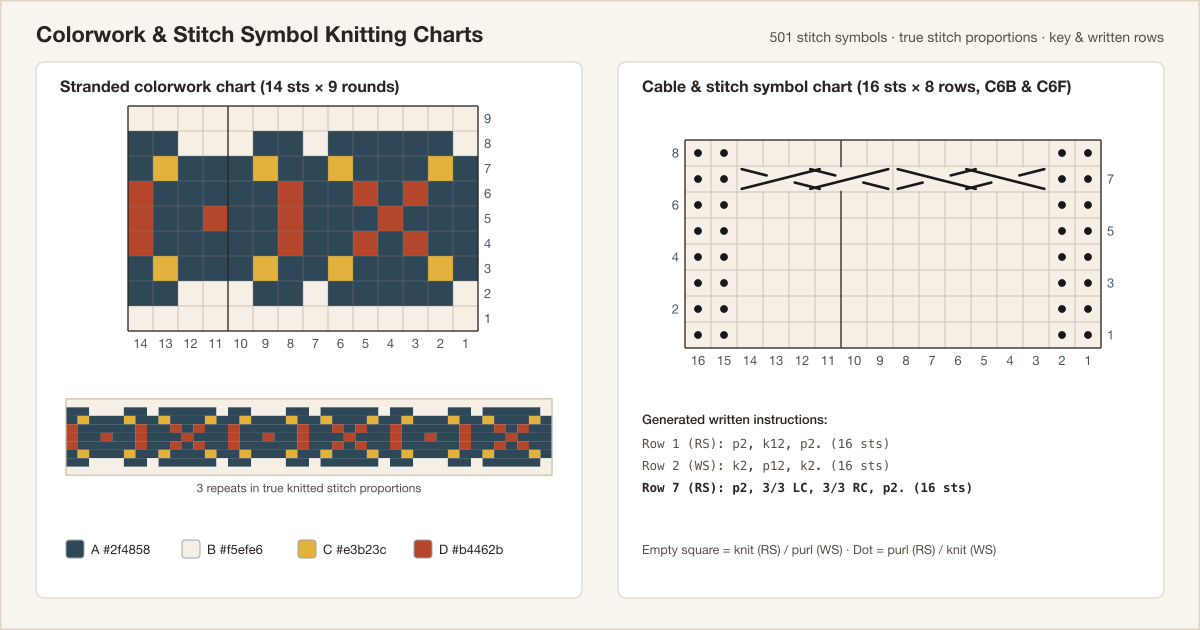
Frequently asked questions
How can I create my own knitting chart?
Set the number of stitches and rows, pick your yarn colors and draw the design one square per stitch. Add symbols for purls, yarn overs, decreases or cables if you need texture, lace or cables. When you are done, download the chart as a PDF or PNG and print it or keep it on your phone.
Can I use it to make crochet charts?
Yes, for crochet worked from a color grid: tapestry crochet, corner-to-corner (C2C) and filet crochet. Enter your crochet gauge so the squares take the shape of your stitches. The stitch symbols are knitting symbols, so for crochet use colors only.
Can I make cable charts?
Yes. There are 300 cable symbols from 2 to 12 stitches wide: right and left crosses, purl cables such as 2/1 RPC, and twisted crosses. Pick one and click the first square; it covers one square per stitch, and the written rows name it. See the cable knitting chart maker for examples.
Can I create a knitting chart from a picture?
Yes. Use the photo to knitting chart converter: choose a photo, set the width in stitches and your gauge, choose how many colors to use, and open the result in the chart editor to tidy it up.
Is this knitting chart maker free?
Yes. Drawing, colors, symbols, PNG downloads, a PDF a day and row-by-row written instructions are free, with no account and no watermark. Optional Knitting Chart Pro plans ($3.99 a month or $24 a year, renews until you cancel; regular price $59 once for lifetime) add as many PDFs as you like, written instructions with repeats merged, copy, paste, move, mirror and repeat tools without a daily count (free 3 times a day), the yarn each color takes, saving charts to your account, sync across devices, charts up to 1000 × 1000 stitches (500 × 500 free), unlimited outlines, unlimited words and sticky notes on the chart (3 per chart free), the knitted look as a picture without the site name (free on screen), a left-hand view for left-handed knitters, custom row numbers, one-click stitch count fixes, a library of your own stitches for every chart, My tiles (motifs and borders you saved, ready to place in any chart), Japanese or dash symbols in downloads, opening written instructions as a chart, opening a colorwork chart from a PDF pattern as a chart to edit, a designer pack (SVG chart and key), the chart as Word, Excel or CSV and a pattern document (several charts in one PDF with your cover, logo and copyright) for patterns you publish. Selecting, copying and drawing your own stitch symbols are free.
Is there an app to make my own knitting charts?
You do not need to install anything: this chart maker runs in the browser on computers, tablets and phones, so it works as a knitting chart app on iPhone, iPad and Android. On a phone, draw with one finger; pinch to zoom and drag with two fingers to move around the chart. To knit from the chart, the pattern tracker follows it row by row; with Pro, a QR code opens it on your phone.
Can I make a knitting chart in Excel or Google Sheets?
You can: make the columns narrow so each cell is one stitch, fill cells with your colors and type the abbreviations. You then work out the stitch proportions, the key and the written rows yourself. Drawing here is quicker: one click per stitch in true stitch proportions, with the key and row-by-row instructions written for you. When you want the chart in a spreadsheet, Knitting Chart Pro downloads it as an Excel file that also opens in Google Sheets and Numbers, with one colored cell per stitch, the abbreviations, row and stitch numbers, a key sheet and the written instructions; anyone can see the preview first. For a blank grid at your gauge, use the knitting graph paper.
How do I convert a written knitting pattern to a chart?
In the chart maker, choose “Written → chart” and paste the rows: it reads lines like “Row 1 (RS): k2, *yo, k2tog; rep from * to last 2 sts, k2”, “Row 2 and all WS rows: purl” and “Rows 5-8: Repeat rows 1-4”, draws the chart as you type and lists any line it could not read. Seeing the chart is free; opening it as a chart to edit, save and print is part of Pro. By hand, make a chart as wide as the stitch count and as tall as the number of rows, then fill one square per stitch from the bottom row up, reading wrong-side rows from left to right and drawing each stitch as it looks from the right side.
Can I turn a chart in a PDF pattern into an editable chart?
Yes, for colorwork charts. In the chart maker, choose “PDF chart → chart”, open the PDF (or a screenshot) and drag a box around the chart: the grid is found, the stitches and rows counted, and every square’s color read, all in your browser — the file is never uploaded. Seeing the result is free; opening it as a chart to change colors and size, save and print is part of Pro. Stitch symbols are not read yet. Use it for patterns you bought or made, to knit or change for yourself.
Can I print the key and instructions in German, Norwegian or Swedish?
Yes, free. Under Download, pick “Key & instructions in” Deutsch, Norsk or Svenska: the PDF, the PNG and the written instructions use that language, with the abbreviations knitters there use (4 re, 2 li; 2 r sammen; 2 rm tills.) and repeats written their way (“von * bis * wiederholen”, “gjenta fra *-*”, “upprepa från *-*”). Everyday stitches are translated; cables and other special stitches keep their English abbreviations.
What is the best software for making knitting charts?
Professional pattern designers often use paid desktop programs. For designing motifs, colorwork and simple lace, a free browser-based chart maker like this one is enough for most knitters, and you can print or share the PDF.
Where are my charts saved?
In your browser on this device, automatically as you draw. Open “My charts” to switch between them. To keep a backup or move a chart to another device, use “Save file” and later “Open file” — or get Knitting Chart Pro, which saves your charts to your account and opens them on all your devices.
Can AI design a knitting pattern?
AI tools can suggest ideas, but they often get stitch counts and shaping wrong. A chart you draw yourself — or convert from a picture and then correct — shows every stitch exactly, so you can check it before you cast on.
Can I make cross-stitch patterns with DMC floss colors here?
Knitting charts use rectangular cells — stockinette stitches have roughly a 4:5 height-to-width ratio, so 4 stitches measure about the same as 5 rows — and match colors to yarn shades. Counted cross stitch on Aida or evenweave uses a 1:1 square grid and counts 8-meter skeins by floss number. For cross stitch with 489 DMC colors (plus Anchor and Cosmo), fabric size checks and skein counts, use our free sister tool, The Cross Stitch Pattern Maker.
Have a picture you want to knit?
Turn a photo, drawing or logo into a colorwork chart in a few seconds.